Believe it or not, but it is already registration time for the fall semester at Hopkins. Amidst the electronic page flipping, deciding whether to take a political economy course in the economics department (with a professor whose class I dropped like a hot lefse) or in the political science department (with the craziest Scottish man since William Wallace), I realized that I haven't even written about my courses here in Botswana. So I shall now rectify that grave injustice.
CIEE requires we take 16 credits, four of which are Setswana courses offered by UB and CIEE, and twelve from the regular university course schedule. This translates, in my case, into four 3-credit courses: two histories, a political science course and an economics course. For the first time in my college career, I have the same professor for two courses: one R.K.K. Molefi for both HIS342 and HIS446. The names of these courses are so ridiculously long, that it might just be easier calling them "Supercalifragilisticexpialidocious I and II". In short, one should be on modern West Africa history, the other on economic growth, policy and development in the developing world. Yet, both have somehow become about Botswana: past, present and future.
HIS 342 has consisted of group presentations for the last month and a half, and has about forty students in it who surprisingly all come to class despite the mindnumbing monotony. It's another story in my intimate, 8 am HIS446. Only eight or so of us are registered and some are in absentia for weeks at a time.
My economics course, billed as Development Policy and Problems, is quite straightforward and standard American university fare. Once again, though, the focus is Botswana. The last course is one of which I'd rather not speak. The first professor, who taught most of the semester thus far, was possibly the worst lecturer I have yet encountered. I think Botswana snails were outpacing his lecture notes and we were no closer to discovering "Politics and Poverty in Southern Africa" two weeks ago than when I got on the airplane in Minneapolis. In fact, we haven't touched on politics or Southern Africa, really.
BUT, have I had an education on Botswana. Even if we have been off topic in all of my classes (although, econ less so), we have been have frank and open conversations about everything Botswana: politics, HIV/AIDS, youth culture, alcohol, education, you name it. And this all something not found in the books listed under "Recommended Reading".
It has been a large adjustment for the group, myself included, to move at a slow pace in all of our endeavors, especially the academic ones. We are now feeling the pressure, however, as we close in on final exams. Professors are cramming in their mid-term assignments (continuing assessments, as they say) just a couple weeks before finals, end-loading their courses greatly in terms of work. This week alone, I am turning in two papers, a project, and presenting on Paul Kruger. This is in part due to my absence from campus next week. Because of a road trip.
Through South Africa.
For nine days.
Exciting!
Find out more in my next post, coming in the next couple of days. And I will try to work some multimedia of some sort in, since this post is visually underwhelming. Apologies.
06 April 2009


02 April 2009
Inside the Botswana Beltway
Life has been pretty ho-hum on campus the past couple of weeks. Not much to report. Before I get to the meat of this post (I apologize for this pun in advance), there is a great piece in the New York Times about how one can acquire a taste for goat. As much as I've come to enjoy seeing herds of dipodi, or goats, crossing highways more intelligently than most pedestrians in American suburbs, I'm not quite sure I will stomach a nice, juicy goat steak on my Ruby Tuesday's menu.
We should be, as my economics professor Dr. Laurence Ball would say, "steaming ahead". This post will try to be as neutral as possible and a disclaimer to all Batswana reading this article: I know that I have only been here a few months and these observations are based upon my own interactions with other Batswana. They may not be representative of every Motswana, but bear with me.
Botswana's claim to fame in Africa is its serenity, thus the lack of traditional Pan-African colors on its flag (photo courtesy of FutureAtlas.com). Instead, the light blue reflects the peace this country has enjoyed in its forty-four years of independence. Unlike most other countries in Africa, Botswana was never colonized in the formal sense and was only taken on as a British protectorate when Botswana's chiefs felt a physical threat from South Africa. Then in 1964, Botswana leaders put forth proposals for independence which were granted and in 1966, Botswana's first general elections were held with the winner being Seretse Khama (left).
Khama is a looming figure in Botswana, not only noted for his central role in creating the modern nation of Botswana, but now his son, Lt. General Seretse Khama Ian Khama is the fourth president. When President Festus Mogae resigned in April 2008, Ian Khama became Botswana's fourth head of state, a number which is not lost on those critical of Botswana's democratic regime.
More than once here, someone has asked me how many presidents America has had. "With Obama, that's 44," I tell them. "See we are forty presidents behind you!" they respond, as if the strength of a democracy is the number of leaders. A quick counter-example in Mexico sticks out, as its one party regime produced a new president every four years for nearly eighty years. The PRI is hardly the democracy I believe Batswana or Americans envy. A more accurate assessment of the situation shows that the US has had nine presidents (including Obama) to Botswana's four since Botswana's independence.
This is still a marked difference, just as the political monopoly held by the Botswana Democratic Party is. Founded by big Khama and now led by little Khama, the BDP has held the majority throughout the nation's history, leading many in the opposition to question the democratic character of Botswana. The main opposition party, the Botswana National Front, currently holds 12 of the 57 seats in the national assembly. My (in geographic terms) representative is one Dumelang Saleshando, the only seated member from the Botswana Congress Party, commonly known as the "most outspoken" MP. Per usual, the opposition parties have their base in the urban areas, and the BDP has very strong appeal in the rural areas.
The current president, however, has shaken the nation in several profound ways. First off, Ian, as we CIEE students affectionately call our new leader, is not seen as truly of Botswana. Raised abroad, his Setswana has not quite attained native fluency. Hard to hold that against him, considering America's own era of presidential grammatical incorrectness. Yet, even more pressing to Batswana is his failure to find a wife and start a family.
It is truly a sad state of affairs to be alone in Setswana culture. Many have pity on my status as an only child, thinking I have no friends or playmates and must therefore be depressed. Families are the ultimate goal of many African traditions, and in the traditional ways, the larger the family, the more powerful the father. My roommate Josh, from Malawi, recounted to me once an argument with an elder of his. "He told me to sit down and said until I had three wives and fourteen children, my opinion didn't matter." It is easy to see then, once again pardon the pun, why some Batswana see the new president impotent in a certain traditional sense.
In the world of policy, the true nuts and bolts of government, the new president has left much to be desired by the nation's progressives. Seeing moral decline as the largest threat facing Botswana, especially reckless driving and alcohol abuse, Ian Khama took his first few political steps in the area of social policy. More specifically, he raised the taxes on alcoholic beverages by 70%, much to the ire of university students and youth in general. More recently, he elevated the fines on traffic violations.
Personally, I can see the rationale. Traffic deaths are the leading cause of death in Botswana, and are at the highest levels in all of southern Africa. Alcohol abuse, which not only increases the amount of traffic accidents, is proliferate in a country with almost 20% unemployment. Many jokes are made about the chibuku (traditional beer) drinkers in Botswana. Ian's newest controversy is the civil dress code, which aims to return a paternal sense of "decency" to the government's female staff. Even the BBC picked up this story.
More worrisome to outside observers is Ian Khama's seeming disinterest in the economic crisis engulfing his country. Debswana, the joint venture between DeBeers diamond company and the government of Botswana, suspended operations in its largest mines. Not only is Debswana the largest diamond mining group in monetary value, it is only responsible for almost half of Botswana's annual revenue. Drastic cuts are being made, and Khama's opponents feel that he has done little to mitigate the damages.
General elections are scheduled for this fall, and the newspapers are littered with political scandal in all parties, but especially within the BDP. Opposition supporters are hoping to steal a majority in the Assembly. The level of political criticism in this country is a testament, despite the somewhat undemocratic nature of the ruling party, to the peaceful and tolerant nature of the Batswana. The ability to speak one's opinion without fear of retribution is something many Americans hold most dear, and it is reassuring to find it so close to the hostile politics of Zimbabwe and South Africa.
I hope you are happy, Miriam. This post sapped the energy out of me on this Thursday night, but I really needed to blog for you all. My next blog will talk about my upcoming road trip through South Africa. Until then, boroko boRra le boMma! (Setswana: Good night, ladies and gentleman!)


We should be, as my economics professor Dr. Laurence Ball would say, "steaming ahead". This post will try to be as neutral as possible and a disclaimer to all Batswana reading this article: I know that I have only been here a few months and these observations are based upon my own interactions with other Batswana. They may not be representative of every Motswana, but bear with me.
Botswana's claim to fame in Africa is its serenity, thus the lack of traditional Pan-African colors on its flag (photo courtesy of FutureAtlas.com). Instead, the light blue reflects the peace this country has enjoyed in its forty-four years of independence. Unlike most other countries in Africa, Botswana was never colonized in the formal sense and was only taken on as a British protectorate when Botswana's chiefs felt a physical threat from South Africa. Then in 1964, Botswana leaders put forth proposals for independence which were granted and in 1966, Botswana's first general elections were held with the winner
 being Seretse Khama (left).
Khama is a looming figure in Botswana, not only noted for his central role in creating the modern nation of Botswana, but now his son, Lt. General Seretse Khama Ian Khama is the fourth president. When President Festus Mogae resigned in April 2008, Ian Khama became Botswana's fourth head of state, a number which is not lost on those critical of Botswana's democratic regime.
More than once here, someone has asked me how many presidents America has had. "With Obama, that's 44," I tell them. "See we are forty presidents behind you!" they respond, as if the strength of a democracy is the number of leaders. A quick counter-example in Mexico sticks out, as its one party regime produced a new president every four years for nearly eighty years. The PRI is hardly the democracy I believe Batswana or Americans envy. A more accurate assessment of the situation shows that the US has had nine presidents (including Obama) to Botswana's four since Botswana's independence.
This is still a marked difference, just as the political monopoly held by the Botswana Democratic Party is. Founded by big Khama and now led by little Khama, the BDP has held the majority throughout the nation's history, leading many in the opposition to question the democratic character of Botswana. The main opposition party, the Botswana National Front, currently holds 12 of the 57 seats in the national assembly. My (in geographic terms) representative is one Dumelang Saleshando, the only seated member from the Botswana Congress Party, commonly known as the "most outspoken" MP. Per usual, the opposition parties have their base in the urban areas, and the BDP has very strong appeal
 in the rural areas.
The current president, however, has shaken the nation in several profound ways. First off, Ian, as we CIEE students affectionately call our new leader, is not seen as truly of Botswana. Raised abroad, his Setswana has not quite attained native fluency. Hard to hold that against him, considering America's own era of presidential grammatical incorrectness. Yet, even more pressing to Batswana is his failure to find a wife and start a family.
It is truly a sad state of affairs to be alone in Setswana culture. Many have pity on my status as an only child, thinking I have no friends or playmates and must therefore be depressed. Families are the ultimate goal of many African traditions, and in the traditional ways, the larger the family, the more powerful the father. My roommate Josh, from Malawi, recounted to me once an argument with an elder of his. "He told me to sit down and said until I had three wives and fourteen children, my opinion didn't matter." It is easy to see then, once again pardon the pun, why some Batswana see the new president impotent in a certain traditional sense.
In the world of policy, the true nuts and bolts of government, the new president has left much to be desired by the nation's progressives. Seeing moral decline as the largest threat facing Botswana, especially reckless driving and alcohol abuse, Ian Khama took his first few political steps in the area of social policy. More specifically, he raised the taxes on alcoholic beverages by 70%, much to the ire of university students and youth in general. More recently, he elevated the fines on traffic violations.
Personally, I can see the rationale. Traffic deaths are the leading cause of death in Botswana, and are at the highest levels in all of southern Africa. Alcohol abuse, which not only increases the amount of traffic accidents, is proliferate in a country with almost 20% unemployment. Many jokes are made about the chibuku (traditional beer) drinkers in Botswana. Ian's newest controversy is the civil dress code, which aims to return a paternal sense of "decency" to the government's female staff. Even the BBC picked up this story.
More worrisome to outside observers is Ian Khama's seeming disinterest in the economic crisis engulfing his country. Debswana, the joint venture between DeBeers diamond company and the government of Botswana, suspended operations in its largest mines. Not only is Debswana the largest diamond mining group in monetary value, it is only responsible for almost half of Botswana's annual revenue. Drastic cuts are being made, and Khama's opponents feel that he has done little to mitigate the damages.
General elections are scheduled for this fall, and the newspapers are littered with political scandal in all parties, but especially within the BDP. Opposition supporters are hoping to steal a majority in the Assembly. The level of political criticism in this country is a testament, despite the somewhat undemocratic nature of the ruling party, to the peaceful and tolerant nature of the Batswana. The ability to speak one's opinion without fear of retribution is something many Americans hold most dear, and it is reassuring to find it so close to the hostile politics of Zimbabwe and South Africa.
I hope you are happy, Miriam. This post sapped the energy out of me on this Thursday night, but I really needed to blog for you all. My next blog will talk about my upcoming road trip through South Africa. Until then, boroko boRra le boMma! (Setswana: Good night, ladies and gentleman!)

23 March 2009
If there's no running water, then you don't have to catch it
It has been an unbelievably fast week, especially by Botswana standards. It was not so much that I accomplished that much, rather that I was constantly on the move. As you may know from the previous post, I spent the last nine days in a village, Mochudi, about forty miles northeast from Gaborone. The caveat was that we weren't staying in Mochudi but commuting every day to class. As most of us had class at 8 am, that meant waking up at quarter to/of five (in numerals, 4:45 am) to make the 5:30 or 6:00 bus. Then we had to leave after our three o'clock afternoon classes to make the 4:30 or 5:00 bus back. Altogether I spent at least four hours a day commuting, ugh.
 BUT . . . my family made up for whatever exhaustion and grumpiness the commuting aroused in me. My mother (to the left), Lebogang, is worthy of her name since it is derived from the Setswana leboga "to thank", something which I cannot do enough of for her. T
 umi, my 12-year old younger brother, attached himself to me as tight as a Kalahari barnacle but as an only child, I understood his want for companionship perfectly.
While Tumi's love for WWE championship wrestling didn't quite mesh with my interest in French expressionism, my astonishing ability to give him piggy-backs and watch Jean Claude van Damme movies without falling asleep ensured instant success with the kid. Throughout the week, we spent a lot of time meeting all of the relatives. My mom has one brother and is herself one of five girls. Adding a certain historicity t o her house, my mom hung up decades-old pictures of her family.
My new home for the week was a simple concrete home with a porch, a large living room fully furnished with satellite TV, a kitchen (without a sink), and four bedrooms. The bathroom you ask? Why, the pit latrines outside. The running water? Why, the spigot out back. Hot water? That's what happens after you boil the water from the spigot out back. Bathing in the morning was more or less me sitting in a plastic tub (sorry for the PG-13 image that conjures) splashing water over myself and the floor.
I only make a point of the water situation because there I was the son of a plumber in the least plumbed of houses. Not to mention garbage disposal consisted of throwing the garbage on a pile in the back yard hidden by trees. (The grandson and nephew of garbage men that I am, How did I find this house?) I jokingly told my mom that my whole family would be better off in Minnesota since they'd be unemployed here.
Despite the village's modest size (around 40,000 Mochudi-ans), it felt quite small and the pace of life made Gaborone feel like a bee hive of activity in comparison. My home sat along a great expanse of floodplain, making the views and walk to the bus stop extremely verdant and truly breathtaking. While everyone I met, and those with whom I only had passing conversation using my ice-breaking Setswana phrases, was very welcoming, I was still met with the most penetrating stares since my arrival at UB. Not too many Americans, i.e. whites, pass through town and very rarely do you see them walking alone and taking local transport or back-alley paths. And we were often alone since every CIEE student lived in different households throughout the village, so there was no accidental run-ins between us. My time with my family was largely constrained during the week due to my traveling and classes at UB, but in the evenings, family life revolved around cooking, eating, washing and most importantly, South African soap operas. More specifically: Generations, Scandal, and Rhythm City. Strangely enough, living in the village afforded me my first opportunity to freely watch television. But make no mistake, lugging water around in five-gallon buckets all day made up for whatever relaxation I gained on the couch.
Sunday is church day, and in fact, one of the Setswana words for Sunday is simply church, Tshipi. Right on time for me here, we showed up about an hour late to church this past Sunday. This week was a local revival for several of the Dutch Reform congregations in Mochudi. Long story short, the Dutch settlers-cum-Boers brought with them their own brand of Protestantism into the northern part of South Africa, near the border with Botswana, where it crossed with the help of the migration of the local tribes. The revival was not quite the Bible Belt experience I had anticipated, but it was filled with spontaneous four-part harmonic singing. It was one of the most moving musical moments or moments musicaux (excessive alliteration, completely unintended) of my life. Three non-stop hours of dancing, singing, clapping, and complete joy.
Ernest Hemingway prefaced his accounts of life in 1920's Paris with the following: "For reasons sufficient to the writer, many places, people, observations and impressions have been left out of this book. Some were secrets and some were known by everyone . . ."
There is no way to recount everything I've done in Mochudi, or in Botswana for that matter, in this blog. I hope, however, that it will provide material for many stories to come when I'm back stateside.

 BUT . . . my family made up for whatever exhaustion and grumpiness the commuting aroused in me. My mother (to the left), Lebogang, is worthy of her name since it is derived from the Setswana leboga "to thank", something which I cannot do enough of for her. T
 umi, my 12-year old younger brother, attached himself to me as tight as a Kalahari barnacle but as an only child, I understood his want for companionship perfectly.
While Tumi's love for WWE championship wrestling didn't quite mesh with my interest in French expressionism, my astonishing ability to give him piggy-backs and watch Jean Claude van Damme movies without falling asleep ensured instant success with the kid. Throughout the week, we spent a lot of time meeting all of the relatives. My mom has one brother and is herself one of five girls. Adding a certain historicity t
 o her house, my mom hung up decades-old pictures of her family.
My new home for the week was a simple concrete home with a porch, a large living room fully furnished with satellite TV, a kitchen (without a sink), and four bedrooms. The bathroom you ask? Why, the pit latrines outside. The running water? Why, the spigot out back. Hot water? That's what happens after you boil the water from the spigot out
 back. Bathing in the morning was more or less me sitting in a plastic tub (sorry for the PG-13 image that conjures) splashing water over myself and the floor.
I only make a point of the water situation because there I was the son of a plumber in the least plumbed of houses. Not to mention garbage disposal consisted of throwing the garbage on a pile in the back yard hidden by trees. (The grandson and nephew of garbage men that I am, How did I find this house?) I jokingly told my mom that my whole family would be better off in Minnesota since they'd be unemployed here.
Despite the village's modest size (around 40,000 Mochudi-ans), it felt quite small and the pace of life made Gaborone feel like a bee hive of activity in comparison. My home sat along a great expanse of floodplain, making the views and walk to the bus stop extremely verdant and truly breathtaking. While everyone I met, and those with whom I only had passing conversation using my ice-breaking Setswana phrases, was very welcoming, I was still met with the most penetrating stares since my arrival at UB. Not too many Americans, i.e. whites, pass through town and very rarely do you see them walking alone and taking local transport or back-alley paths. And we were often alone since every CIEE student lived in different households throughout the village, so there was no accidental run-ins between us.
 My time with my family was largely constrained during the week due to my traveling and classes at UB, but in the evenings, family life revolved around cooking, eating, washing and most importantly, South African soap operas. More specifically: Generations, Scandal, and Rhythm City. Strangely enough, living in the village afforded me my first opportunity to freely watch television. But make no mistake, lugging water around in five-gallon buckets all day made up for whatever relaxation I gained on the couch.
Sunday is church day, and in fact, one of the Setswana words for Sunday is simply church, Tshipi. Right on time for me here, we showed up about an hour late to church this past Sunday. This week was a local revival for several of the Dutch Reform congregations in Mochudi. Long story short, the Dutch settlers-cum-Boers brought with them their own brand of Protestantism into the northern part of South Africa, near the border with Botswana, where it crossed with the help of the migration of the local tribes. The revival was not quite the Bible Belt experience I had anticipated, but it was filled with spontaneous four-part harmonic singing. It was one of the most moving musical moments or moments musicaux (excessive alliteration, completely unintended) of my life. Three non-stop hours of dancing, singing, clapping, and complete joy.
Ernest Hemingway prefaced his accounts of life in 1920's Paris with the following: "For reasons sufficient to the writer, many places, people, observations and impressions have been left out of this book. Some were secrets and some were known by everyone . . ."
There is no way to recount everything I've done in Mochudi, or in Botswana for that matter, in this blog. I hope, however, that it will provide material for many stories to come when I'm back stateside.

12 March 2009
Heading to the Village
One component of the CIEE-Botswana program that aims to immerse us in Setswana culture and language is a home stay in a nearby village of Gaborone. We learned a while ago that our home stay would be in the village of Mochudi, which is approximately 35 kilometers north of Gaborone. Now while we have already been to Mo chudi, our visit was limited to the Phuthadikobo Museum, which has an extensive web site. As I've noted in an earlier blog, Mochudi is well known for its strong ties to traditional ways, including a kgotla (the village meeting place where communal decisions are made) and brightly painted houses.
We leave this Saturday for Mochudi on an 8 am shuttle, and will remain there all of next week until the following Sunday. This translates numerically to the 14th until the 22nd. On the weekdays we will still have to come to classes at UB, which should be very fun considering every day my classes start at 8 in the morning. Considering it's over an hour each way, I will be waking up with the sun and roosters to catch the combi in to town.
This small detail doesn't bother me all that much, as almost all the CIEE students have class that early, so we can commiserate in our Politics and Poverty of Southern Africa class. Today, I found out who my host family is, and somehow in a country with a fertility rate hovering around three children per mother, I was placed with a mother and her 12-year old son. Do not take this the wrong way; I am ecstatic about the set up. As an only male child, I am sure that I will be able to get along with/understand my new host brother much better. Moreover, my host mom is a local teacher in Mochudi. I'm hoping her teaching skills extend to Setswana over family dinners; I am in sore need of practice!
I think many of us are dealing with mixed expectations vis-à-vis the homestay but now with our family's demographics in hand I think we can now construct a realistic expectation of the week-long experience. Plus, didn't I mention the view from the hill is amazing?
 In other news, we had an unexpected and sad visit from Zimbabwean Prime Minister Morgan Tsvangirai in Gaborone. Here is a link to the tragic story about Tsvangirai's car accident which resulted in his hospitalization here in Botswana and his wife's death. Batsi, our CIEE director and Zimbabwean, returned from a trip home with both news and a surprise. Of the incident, he said the national mood is one of mourning and this event may have advanced the cause of the new unity government in ways unforeseen just days earlier.
The surprise was both welcome and, literally, completely worthless: a 50-billion Zimbabwe Dollar note for each of us. One could hardly buy a few text messages here with that.
Borrowing from Garrison Keillor, whose impression of Lake Wobegon is not too dissimilar to mine of Botswana: And that's the news from Gaborone, "the little town that time forgot and the decades cannot improve . . . where all the women are strong, all the men are good-looking, and all the children are above average."
 chudi, our visit was limited to the Phuthadikobo Museum, which has an extensive web site. As I've noted in an earlier blog, Mochudi is well known for its strong ties to traditional ways, including a kgotla (the village meeting place where communal decisions are made) and brightly painted houses.
We leave this Saturday for Mochudi on an 8 am shuttle, and will remain there all of next week until the following Sunday. This translates numerically to the 14th until the 22nd. On the weekdays we will still have to come to classes at UB, which should be very fun considering every day my classes start at 8 in the morning. Considering it's over an hour each way, I will be waking up with the sun and roosters to catch the combi in to town.
This small detail doesn't bother me all that much, as almost all the CIEE students have class that early, so we can commiserate in our Politics and Poverty of Southern Africa class. Today, I found out who my host family is, and somehow in a country with a fertility rate hovering around three children per mother, I was placed with a mother and her 12-year old son. Do not take this the wrong way; I am ecstatic about the set up. As an only male child, I am sure that I will be able to get along with/understand my new host brother much better. Moreover, my host mom is a local teacher in Mochudi. I'm hoping her teaching skills extend to Setswana over family dinners; I am in sore need of practice!
I think many of us are dealing with mixed expectations vis-à-vis the homestay but now with our family's demographics in hand I think we can now construct a realistic expectation of the week-long experience. Plus, didn't I mention the view from the hill is amazing?
 In other news, we had an unexpected and sad visit from Zimbabwean Prime Minister Morgan Tsvangirai in Gaborone. Here is a link to the tragic story about Tsvangirai's car accident which resulted in his hospitalization here in Botswana and his wife's death. Batsi, our CIEE director and Zimbabwean, returned from a trip home with both news and a surprise. Of the incident, he said the national mood is one of mourning and this event may have advanced the cause of the new unity government in ways unforeseen just days earlier.
The surprise was both welcome and, literally, completely worthless: a 50-billion Zimbabwe Dollar note for each of us. One could hardly buy a few text messages here with that.
Borrowing from Garrison Keillor, whose impression of Lake Wobegon is not too dissimilar to mine of Botswana: And that's the news from Gaborone, "the little town that time forgot and the decades cannot improve . . . where all the women are strong, all the men are good-looking, and all the children are above average."
11 March 2009
Campus
I apologize for my dismal updating this past week. It should have been a great time to catch up on different aspects of life in Botswana, but I blame the heat for my laziness. That or I am picking up the African ability to spend hours doing nothing and enjoy it. While I have a couple more substantial blogs coming up answering your questions, I thought I would share a few pictures of campus and the surroundings for your enjoyment. You may be wondering where the students are. I took these pictures early in the morning and in the evening, when campus is literally empty. Someday I'll be touristy enough to pull out the camera during the day. No worries. Cheers!
 A sunset over the sparse Gaborone skyline
 A view of the student center, with our dorms right behind the clock tower.
 The UB Library, one of the most complete in all of Africa. The small buildings in front are normal classroom buildings.
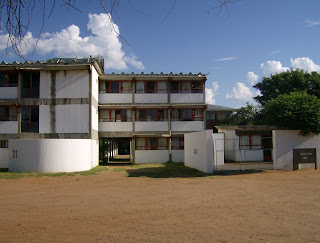 A typical undergraduate dorm, with the ubiquitous red and white color scheme
 The "Graduate Village" as Block 417 is so affectionately known. This is what I call home here at UB. Each suite consists of six singles, a shower, a toilet, and a combined kitchen/common area. It's a better set-up than most of us have at our American universities, believe it or not.
.
 A sunset over the sparse Gaborone skyline
 A view of the student center, with our dorms right behind the clock tower.
 The UB Library, one of the most complete in all of Africa. The small buildings in front are normal classroom buildings.
 A typical undergraduate dorm, with the ubiquitous red and white color scheme
 The "Graduate Village" as Block 417 is so affectionately known. This is what I call home here at UB. Each suite consists of six singles, a shower, a toilet, and a combined kitchen/common area. It's a better set-up than most of us have at our American universities, believe it or not.
.
03 March 2009
What's on your mind?
While brushing my teeth, a time of much prodigious thought for me, it occurred to me that I should ask you what YOU want to know. From me, about Botswana, that is.
It's all fair game.
All you have to do is leave me a question in the comment space or in an email. I hope this experiment works and just to make sure it does, I will invoke the great Setswana call for luck, rain, money, etc:
PULA! PULA! PULA!
It's all fair game.
All you have to do is leave me a question in the comment space or in an email. I hope this experiment works and just to make sure it does, I will invoke the great Setswana call for luck, rain, money, etc:
PULA! PULA! PULA!
Wait, there aren't Barnes & Nobles in Africa?
Despite the lack of in-store Starbucks serving caramel macchiatos, the bookstores have some interesting selections: Criminal Law of Botswana, Setswana-English phrasebooks and the latest from Robert Ludlum of "Bourne Identity" fame. While I have not been reading nearly as quickly as I'd like, (the heat sure takes a lot out of me during the day) I have made significant progress on a number of books. This blog will give my take, thus far, on a number of  books and a few CD's from and about Africa.
First up on the review is Martin Meredith's "Mugabe: Power, Plunder and the Struggle for Zimbabwe". I just finished it tonight and it was like everything else I've read by Meredith: straightforward, accessible, and concise. With people already familiar with Meredith's subject matter, it will probably not be of great use, but as a Zimbabwe crisis primer, it's indispensable. The 2007 update of the original 2002 edition only proves how hopelessly stagnant the situation is next door to Botswana. Check it out on Amazon.

The first president of Botswana was at one time exiled before independence. Why? Because he married a white woman. Susan Williams' "Colour Bar: The Triumph of Seretse Khama and his Nation" follows the star-crossed marriage of Seretse and Ruth Khama when Botswana was still Bechuanaland, a British protectorate. Their marriage was condemned by apartheid South Africa and nearly caused conflict between the UK and South Africa. Williams' writing is extremely well-researched, lucid and surprisingly riveting. Khama remains a great figure in Botswana and knowing his story is knowing Botswana's. Available here.
Like geology? Agriculture? Economics? There is little that is not covered John Reader's encyclopedic and almost self-aggrandizing "Africa: A Biography of the Continent ". The 682-page tome includes chapters like "Zulu Myth and Realities", "Bananas and Cattle", and "The Invention of Africa". Each chapter is nearly self-contained, and chock-full of fascinating facts. What sets this project apart, however, is that the majority of the book is about Africa before formal colonialism began in the 1880's. Reader pushes us to explore the history of a continent long before military coups were the norm, while simultaneously dispelling myths of a pastoral Arcadia. Mosquitos and elephants have determined the farming patterns of Africans for centuries, hampering local economies long before IMF structural adjustment loans existed. For those willing brave enough to tackle this behemoth biography, it's well worth it.
The only novel I've been reading here in Botswana, is actually Kenyan. Perhaps the country's most famous native son, Ngugi wa Thiong'o, was imprisoned as a political prisoner in the 1970's. His novels are snapshots and critiques of life and politics in Kenya and "Devil on the Cross" is no exception. In fact, according to legend, Ngugi wrote it on the prison's toilet paper. As I'm only halfway through I don't feel I can give it a just review. When I'm done, perhaps I will share some more thoughts.
What's this? You want to shake what your African mother gave you? Yes, music, the music of Mother Africa. While "house" music is the musique du jour here in Botswana, most of us Americans find the heavy beats and techno-feel a bit overwhelming, leaving us reaching for the Advil. But just as hip-hop does not need to define American music, "house" music is only one facet of a continent known for its complicated rythyms and musicality.
First off, two African giants are worth listening to no matter which CD you find: Miriam Makeba, of South Africa, and Youssou N'Dour, of Senegal. Along with Ladysmith Black Mambazo, also from South Africa, these African artists have made a name for contemporary African music in the wider world. Now for more of my finds while here in Botswana . . .
South African music is huge in this country. There are a multitude of reasons for this. Botswana's small population and economy have always been tightly linked to South Africa, and the large musical output coming from Jo-burg to Cape Town is no match for the up-and-comers from Gaborone. It is no surprise, then, that one can hear Brenda Fassie, the so-called Queen of African Pop, on any radio station. One of my favorites is her track "Nomakanjani", although many locals prefer her big hits like "Weekend Special". The latter I heard while on my bus ride from Kasane to Francistown and couldn't resist humming along. I'm finally fitting in . . .
Yet another South African musical invader is the township music out of Johannesburg. With a long history stretching back before the student riots in Soweto, township music has undergone many transformations from a laid-back, reggae-like feel to the more contemporary kwaito. Some artists on my compilation include Chirro, Yvonne Chaka Chaka, and Cijamlenze Nkwanyana. If you've ever seen a documentary of Hollywood film about Africa, watch the scene where the journalist is driving in a cramped bus, and this is inevitably the soundtrack.

Up last is local hit, Captain Dira, whose new album "Ke Itse Keje" is advertised everywhere in town. Against traditional African gospel harmony and whistles, Captain Dira takes on difficult relationship issues and social vices like drugs. Now only if I knew enough Setswana to understand the lyrics, I am sure the contrast between the words and the upbeat music would be fascinating. Alas, tis not the case.
More so than any other post, the hyperlinks here are very useful. Much of this music is hard to buy in the US, and so I encourage you to waste away a day at work on Youtube, clicking, clicking, clicking away! And while you're at it, get up, and shake what this traditional Setswana mother gave ya.
 books and a few CD's from and about Africa.
First up on the review is Martin Meredith's "Mugabe: Power, Plunder and the Struggle for Zimbabwe". I just finished it tonight and it was like everything else I've read by Meredith: straightforward, accessible, and concise. With people already familiar with Meredith's subject matter, it will probably not be of great use, but as a Zimbabwe crisis primer, it's indispensable. The 2007 update of the original 2002 edition only proves how hopelessly stagnant the situation is next door to Botswana. Check it out on Amazon.

The first president of Botswana was at one time exiled before independence. Why? Because he married a white woman. Susan Williams' "Colour Bar: The Triumph of Seretse Khama and his Nation" follows the star-crossed marriage of Seretse and Ruth Khama when Botswana was still Bechuanaland, a British protectorate. Their marriage was condemned by apartheid South Africa and nearly caused conflict between the UK and South Africa. Williams' writing is extremely well-researched, lucid and surprisingly riveting. Khama remains a great figure in Botswana and knowing his story is knowing Botswana's. Available here.
Like geology? Agriculture? Economics? There is little that is not covered John Reader's encyclopedic and almost self-aggrandizing "Africa: A Biography of the Continent
 ". The 682-page tome includes chapters like "Zulu Myth and Realities", "Bananas and Cattle", and "The Invention of Africa". Each chapter is nearly self-contained, and chock-full of fascinating facts. What sets this project apart, however, is that the majority of the book is about Africa before formal colonialism began in the 1880's. Reader pushes us to explore the history of a continent long before military coups were the norm, while simultaneously dispelling myths of a pastoral Arcadia. Mosquitos and elephants have determined the farming patterns of Africans for centuries, hampering local economies long before IMF structural adjustment loans existed. For those willing brave enough to tackle this behemoth biography, it's well worth it.
The only novel I've been reading here in Botswana, is actually Kenyan. Perhaps the country's most famous native son, Ngugi wa Thiong'o, was imprisoned as a political prisoner in the 1970's. His novels are snapshots and critiques of life and politics in Kenya and "Devil on the Cross" is no exception. In fact, according to legend, Ngugi wrote it on the prison's toilet paper. As I'm only halfway through I don't feel I can give it a just review. When I'm done, perhaps I will share some more thoughts.
What's this? You want to shake what your African mother gave you? Yes, music, the music of Mother Africa. While "house" music is the musique du jour here in Botswana, most of us Americans find the heavy beats and techno-feel a bit overwhelming, leaving us reaching for the Advil. But just as hip-hop does not need to define American music, "house" music is only one facet of a continent known for its complicated rythyms and musicality.
First off, two African giants are worth listening to no matter which CD you find: Miriam Makeba, of South Africa, and Youssou N'Dour, of Senegal. Along with Ladysmith Black Mambazo, also from South Africa, these African artists have made a name for contemporary African music in the wider world. Now for more of my finds while here in Botswana . . .
South African music is huge in this country. There are a multitude of reasons for this. Botswana's small population and economy have always been tightly
 linked to South Africa, and the large musical output coming from Jo-burg to Cape Town is no match for the up-and-comers from Gaborone. It is no surprise, then, that one can hear Brenda Fassie, the so-called Queen of African Pop, on any radio station. One of my favorites is her track "Nomakanjani", although many locals prefer her big hits like "Weekend Special". The latter I heard while on my bus ride from Kasane to Francistown and couldn't resist humming along. I'm finally fitting in . . .
Yet another South African musical invader is the township music out of Johannesburg. With a long history stretching back before the student riots in Soweto, township music has undergone many transformations from a laid-back, reggae-like feel to the more contemporary kwaito. Some artists on my compilation include Chirro, Yvonne Chaka Chaka, and Cijamlenze Nkwanyana. If you've ever seen a documentary of Hollywood film about Africa, watch the scene where the journalist is driving in a cramped bus, and this is inevitably the soundtrack.

Up last is local hit, Captain Dira, whose new album "Ke Itse Keje" is advertised everywhere in town. Against traditional African gospel harmony and whistles, Captain Dira takes on difficult relationship issues and social vices like drugs. Now only if I knew enough Setswana to understand the lyrics, I am sure the contrast between the words and the upbeat music would be fascinating. Alas, tis not the case.
More so than any other post, the hyperlinks here are very useful. Much of this music is hard to buy in the US, and so I encourage you to waste away a day at work on Youtube, clicking, clicking, clicking away! And while you're at it, get up, and shake what this traditional Setswana mother gave ya.
Subscribe to:
Posts (Atom)


